Why Reuse Saves Money
Invest once. Use it many times. Keep process costs under control.
A clothes hanger costs money. But how often do you actually have to pay for it?
At first glance, this question may seem trivial. However, it touches on one of the most important economic principles underlying the circular economy.
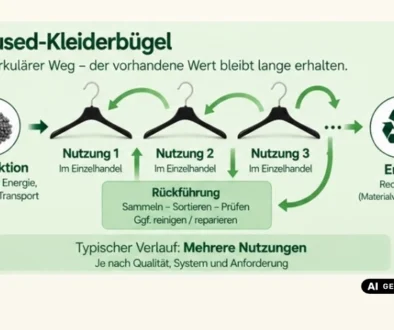
In the traditional procurement model, a coat hanger is purchased, used once, and then discarded or recycled.
Its original purchase cost thus corresponds to only a single use.
An economically organized reusable cycle fundamentally changes this equation.
1. One-time investment—multiple benefits
A clothes hanger is, first and foremost, a finished product.
It includes raw materials, energy, production costs, and transportation costs.
Why should this value, which has already been created, be discarded after the first use if the hanger is still in perfect working order?
Any further use can increase the economic value of the original investment.
The bracket does not need to be manufactured again for this purpose. It simply needs to be available again in the appropriate quality and at the right time.
A single-use consumable becomes a reusable item.
2. The unit price is not the key metric
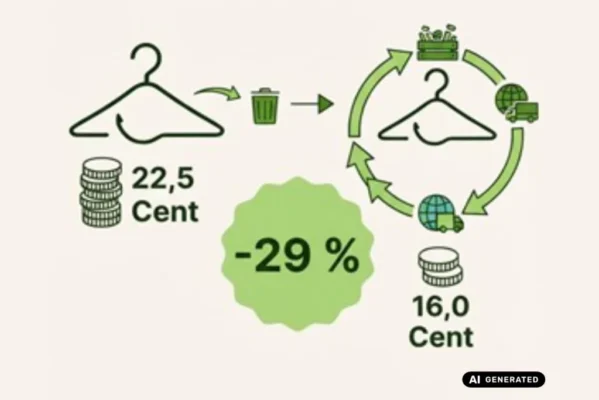
Let’s assume an average price of 22.5 cents for a new iron, delivered free of charge.
For one-time use, the acquisition cost is 22.5 cents per use.
To ensure a professionally organized reuse cycle, we assume the following average process costs:
- Collection and return: 3.5 cents
- Sorting and Classification: 7.5 cents
- Global Distribution: 5.0 cents
Total: 16.0 cents per reused hanger.
This corresponds to a calculated difference of 6.5 cents per reuse compared to purchasing a new item.
Or approximately 29% lower direct provision costs.
Of course, these figures do not yet constitute a complete cost-benefit analysis. Losses due to wear and tear, replacement purchases, inventory costs, and other system costs must also be taken into account.
But they highlight the economic potential.
3. Total Cost of Ownership—Looking at the Entire System
The key metric is not just the purchase price.
It is the total cost over the useful life, known as the Total Cost of Ownership (TCO).
In addition to the initial procurement, these include, among other things:
Collection, transportation, sorting, quality inspection, storage, repairs, losses, replacement, and final material recycling.
To ensure a fair comparison, the costs of the single-use system must also be fully taken into account, including any disposal and administrative expenses.
Only then will we realize which system is truly superior from an economic standpoint.
4. Litigation costs determine success
A reusable system is not automatically cost-effective.
Inappropriate collection containers, low transport utilization, too many types of hangers, or unnecessary handling steps can quickly erode the cost advantage.
That is why a successful circular economy doesn’t start with sorting.
It begins with product selection, standardization, in-store organization, and the design of the entire supply chain.
The simpler the processes, the more cost-effective reuse can become.
5. Ecology and economics are not opposites
For me, this is precisely where one of the most interesting insights from more than three decades of coat hanger management lies.
A circular economy does not necessarily mean that we have to accept higher costs in the name of greater sustainability.
A well-organized reusable product cycle can simultaneously:
- reduce the demand for brand-new hangers,
- use existing products for longer,
- Minimize the use of materials and energy,
- Reduce disposal costs and
- reduce the cost per successful use.
This is not a contradiction between ecology and economics.
It is the economically smarter use of existing resources.
My Conclusion
The question should no longer be limited to:
“How cheaply can we buy a new clothes hanger?”
Rather:
“How cost-effectively can we reuse an existing clothes hanger?”
Anyone who can answer this question no longer views the coat hanger as merely a cost factor.
Rather, as part of a controllable, measurable, and economically viable circular economy.
And that’s exactly what green hanger is all about:
Turning costs into economic benefits.
In the next post, 1.06: “Reusable Hangers: A Market of the Future—Why the Circular Economy Must Be Thought of Globally.”
I’m interested in your experience: Does your company already evaluate hangers based on their cost per use—or is the purchase price still the main factor?
#GreenHanger #GarmentHangers #HangerReuse #HangerLoop #ReusableHangers #ApparelIndustry #FashionRetail
Optimized by AI
About the Author

Hermann Bode
Author of *Green-Hanger* and expert on global coat hanger cycles.