Recycling or Reuse?
Why the coat hanger as a whole is initially more valuable than the materials it’s made of
“Our hangers are made from recycled materials.”
I’ve been hearing this phrase for many years. And most of the time, it’s meant as a compliment.
Recycling is considered sustainable. Plastic is collected, shredded, processed, and then reused as a raw material. Compared to incineration or landfilling, this is undoubtedly an important part of the modern circular economy.
But even so, we should ask one question:
Why would we even want to shred a coat hanger that still works?
If a product continues to function as intended, it might make more sense to continue using it for that very purpose for the time being.
This brings us to one of the most important core principles of green hanger:
Reuse Before Recycling – Reuse products as long as it makes sense to do so. Recycle them when they are truly at the end of their useful life.
Two terms that are often confused
Reuse and recycling share the same overarching goal: to use resources as efficiently as possible and to prevent waste.
But the paths to get there are fundamentally different.
When reused, the product essentially remains intact.
A coat hanger is collected, inspected, sorted, cleaned or repaired as needed, and then reused as a coat hanger.
In recycling, on the other hand, the product’s original function is abandoned.
The coat hanger becomes the raw material for a new production process. Depending on its design, this requires separating components such as plastic, metal hooks, clips, or other parts from one another. The plastic is shredded, cleaned, sorted, and, if necessary, processed into a secondary raw material.
After that, this material can be turned into a new product.
The difference is fundamental:
With reuse, we recover as much of the existing product as possible. With recycling, we recover as much of its material as possible.
Both are forms of a circular economy.
But it’s not the same thing.
The European waste hierarchy makes precisely this distinction
This perspective is not something Green Hanger came up with.
European waste legislation also follows a clear order of priorities.
Put simply, it goes like this:
Prevention → Preparation for Reuse → Recycling → Other Recovery → Disposal
That makes sense.
The longer an existing product can be put to good use, the longer the raw materials, energy, and production services already used in its manufacture will retain their original function.
Reuse therefore initially extends the product life cycle.
Recycling closes the material cycle later on.
That is why we should not ask:
“Reuse or Recycle?”
Instead, it would be better to say:
“When to reuse—and when to recycle?”
A clothes hanger is made of more than just plastic and metal
A used clothes hanger is sometimes viewed as nothing more than a certain amount of plastic and metal.
That doesn’t go far enough.
Because there’s actually a lot more to this coat hanger than meets the eye.
Raw materials were extracted.
Plastic was manufactured and processed.
Metal was produced and shaped into a hook or clip.
Tools and machines were used.
Energy was consumed.
The bracket was assembled, packaged, and transported.
And eventually, we’ll have a fully functional coat hanger right in front of us.
If we crush this hanger now, we may be able to recover a significant portion of its materials.
But first, we’ll disable its existing product functionality.
This is precisely where the key difference between reuse and recycling lies.
What does that mean for CO₂?
When it comes to CO₂ considerations, we should also be cautious about making sweeping statements.
It would be irresponsible to claim:
“Reuse generally results in lower CO₂ emissions than recycling.”
Whether this applies in a specific case depends on the system as a whole.
For example, from:
- Transportation distances,
- Transport capacity,
- Collection structure,
- Sorting effort,
- Reuse rate,
- necessary cleaning or repair,
- Material type,
- Recycling processes,
- Energy supply,
- Service life of the bracket and
- the question of which new production is actually avoided.
Nevertheless, reuse offers an important systemic advantage:
It can prevent or delay the production of a replacement product.
It is precisely this avoided production cost that must be taken into account in a rigorous life-cycle assessment.
Therefore, the right question about CO₂ is not:
“How much CO₂ is emitted when a used iron is shipped back?”
Rather:
“What additional emissions does its reuse cause—and what emissions from new production are avoided as a result?”
Only by comparing both sides can we get a clear picture.
And what about energy?
The situation is similar when it comes to energy consumption.
Recycling requires energy.
Plastics must be collected, sorted, often shredded, separated from foreign materials and metal components, and processed into a usable secondary raw material.
This is followed by the production of a new product.
Of course, reuse also requires energy.
The hangers must be collected and transported. Sorting systems, conveyor systems, and warehouses require energy. Depending on the system, cleaning, repairs, and additional transportation may also be required.
So, once again, the question is not:
“Which process consumes energy?”
Because they both do.
The right question is:
“Which process yields the greatest possible utility with the least possible additional energy and resource input?”
When it comes to a coat hanger that is in good condition, standardized, and reusable, there are many reasons to preserve its existing function for as long as possible.
The resource we don’t have to use again
The circular economy is often reduced to recycling rates.
Yet there is another lever that is at least as important:
Use products for longer.
If an existing hanger is reused, it is not necessarily necessary to manufacture an additional new hanger for that cycle.
This means that the demand for:
- new plastic,
- Metal,
- Production energy,
- Production capacity,
- Packaging and
- the associated upstream processes
reduce.
That does not mean that for every hanger that is reused, exactly one fewer new hanger is automatically produced. Actual product flows, inventory reserves, loss rates, and changes in hanger models make the calculation more complex.
But that is precisely why companies should measure their actual cycles.
How many hangers do we put into circulation? How many do we get back? How many of those can be reused? How many cycles do they go through?
Then a sustainability statement becomes a measurable business metric.
A circular economy means preserving value
Perhaps looking at it from a different perspective will help.
Let’s imagine three levels:
- Function retained
The hanger remains a hanger and is reused. - Material received
The coat hanger can no longer be put to good use and will be broken down into its recyclable materials. - Generating or eliminating energy
Only when high-quality material recycling is not a practical option should downstream options be considered.
With each step, we give up a portion of the value we have already created.
That is why a well-functioning circular economy seeks to keep a product at the highest possible level of value for as long as possible.
For the coat hanger, this means:
First, focus on the function. Then, the material.
But reuse is not an end in itself
At this point, I would like to make one important clarification.
Not every clothes hanger should be reused at any cost.
If a hanger is damaged, its structural integrity can no longer be guaranteed, or refurbishing it would be unreasonably costly, recycling may be the more sensible solution.
The same applies if, for example, a reuse system results in extremely long additional transport distances, very low return rates, or disproportionately high processing costs.
That is why the European waste hierarchy does not call for the blind application of a single approach. Ultimately, what matters is achieving the best environmental outcome, taking the life cycle into account.
I think that’s an extremely important point.
After all, sustainability should not be evaluated based on ideology, but rather on the actual system.
Here’s an example: 100 hangers are returned
Let’s take a deliberately simplified example.
100 used hangers are being returned from retail stores.
After sorting, we find that:
85 hangers are in perfect working order and can be reused.
5 hangers can be repaired with reasonable effort.
10 hangers are no longer usable.
What would be the purpose of a smart circular economy?
Don’t recycle all 100 hangers just because recycling is possible.
Instead, if possible:
90 hangers back into the product cycle.
And:
10 hangers in a high-quality material cycle.
This ensures that reuse and recycling do not work against each other.
They complement each other.
And that, in my view, is precisely where one of the biggest misunderstandings in the public debate lies.
Reuse Requires Recycling
People who advocate for reuse are not against recycling.
On the contrary.
A professional reusable system requires an equally professional recycling process.
After all, no coat hanger can be reused indefinitely.
At the end of its technically or economically viable useful life, it must be ensured that the materials it contains are recovered to the highest possible standard.
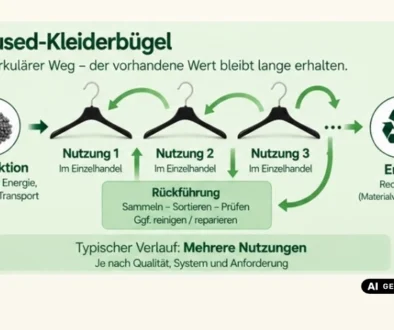
A good clothing hanger cycle therefore consists of two interconnected cycles:
Product Life Cycle:
Use → Collect → Sort → Inspect → Reuse → Use Again
and then:
Material Cycle:
Sorting → Separation → Processing → Recycled Raw Material → New Product
Ideally, the material cycle begins where the product cycle logically ends.
And what is the economic benefit?
This brings us back to our central theme.
Ecology alone cannot sustain an industrial cycle in the long run.
A trading company must also know:
How much does the system cost us—and what economic benefits does it generate?
A new clothes hanger has a purchase price.
A reused hanger, on the other hand, incurs costs for return, sorting, storage, and, if necessary, repair.
These costs must be compared with one another.
But here, too, a focus solely on unit costs would be too narrow a view.
In addition, there are, for example:
- disposal costs avoided,
- reduced new purchases,
- lower demand for primary raw materials,
- Logistical effects,
- Inventory Management,
- Rejection rates and
- the number of cycles actually completed.
Only then can a sound economic assessment be made.
What might seem like a waste disposal problem can thus be transformed into a manageable cycle with measurable economic benefits.
The key question, therefore, is not: recycling or reuse?
Both are needed.
The key question is:
How long can we reasonably maintain the current value of a clothes hanger before we move down to the next lower value level?
As long as the bracket is technically suitable and its reuse makes sense from both an environmental and economic standpoint, its function should be utilized.
If that is no longer possible, its materials should be recovered to the highest possible standard.
And only when that, too, is not a practical option are other recycling or disposal methods considered.
Understood in this way, the circular economy is not a matter of a single “green” label.
It involves process optimization throughout a product’s entire life cycle.
That is exactly why purchasing, logistics, and sustainability management should not view a clothes hanger in isolation.
The purchasing department sees the price.
Logistics finds its way.
Sustainability management takes resources and emissions into account.
Management should have a view of the entire system.
Because only then can we determine which solution is actually better.
In the next post: “New or Reused—Which Hanger Is Truly More Sustainable?”
Then let’s take it a step further.
We compare a newly manufactured coat hanger with an existing, reused one—not based on emotional considerations, but on the basis of its key environmental and economic factors.
And perhaps in the process we’ll realize that the most important question isn’t what a clothes hanger is made of.
But first:
How often do we use it?
#GreenHanger #GarmentHangers #HangerReuse #HangerLoop #ReusableHangers #ApparelIndustry #FashionRetail
Optimized by AI
About the Author

Hermann Bode
Author of *Green-Hanger* and expert on global coat hanger cycles.