New vs. Used—An Economic Perspective
A new hanger or a reused one? Which is really the better choice?
New is better.
That thought runs deep.
A new product gives the impression of being clean, reliable, technically straightforward, and of verifiable quality. A used product, on the other hand, is initially associated by many people with wear and tear, uncertainty, or lower quality.
When it comes to a coat hanger, this very way of thinking can lead to the wrong decision.
Because the real question isn’t:
Is the hanger new or used?
Rather:
Does it meet the system’s technical requirements, quality standards, and economic requirements?
If a clothes hanger meets these requirements, reusing it may make more sense—both environmentally and economically—than replacing it prematurely with a new product.
But here, too, the central theme of green hanger applies:
Don’t just take it on faith. Compare.
At first, “new” and “reused” are simply two different starting points
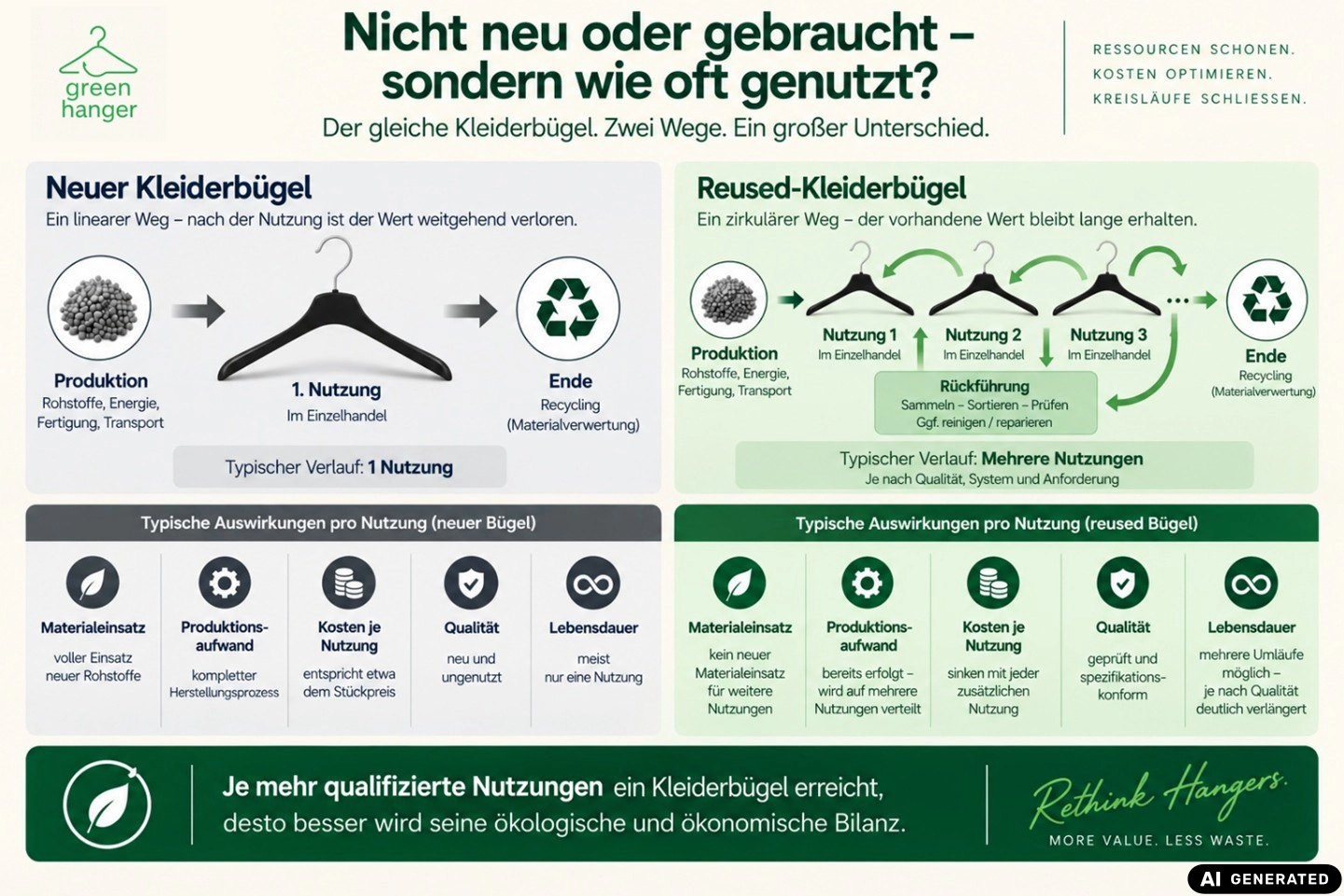
A new coat hanger comes straight from the production line.
A “Reused” hanger has already been through at least one cycle.
At first glance, this distinction doesn’t tell us anything more.
It is not yet possible to conclude from this alone whether one of the two hangers is of higher quality, more environmentally friendly, or more economical.
For example, a poorly designed new hanger may not last as long as a high-quality reusable hanger that has already successfully been through several cycles.
Conversely, a used hanger should, of course, not be reused if it is structurally damaged, deformed, or no longer suitable for its intended use.
Therefore, the relevant category is not ” new” or “used.”
The relevant category is:
suitable or not suitable.
1. Ecology: What actually needs to be created from scratch for the next operation?
Let’s start with the environmental perspective.
To make a new clothes hanger, materials must be sourced, processed, and shaped into a new product.
Depending on the type of iron, these include, for example:
- Plastics,
- Metal for hooks or clips,
- Production energy,
- Machine processes,
- Packaging,
- internal logistics and
- Transport to the scene.
A reusable clothes hanger, on the other hand, already exists.
Its initial production has already taken place.
A subsequent cycle gives rise to other costs:
- Collection,
- Return transport,
- Sorting,
- Quality Control,
- cleaning, if necessary,
- Repair,
- Storage and
- Redistribution.
The environmental question is therefore:
What additional expenses will be incurred for the next usage transaction?
That is precisely where the potential benefit of reuse lies.
If an existing product can be reused with relatively little additional effort, there is no need to manufacture a completely new replacement product for that purpose.
The European Environment Agency explicitly describes extending product lifespans, reuse, and repair as essential elements of a circular economy, because these measures can reduce the demand for new products and new raw materials.
But even “reused” isn’t automatically better for the environment
At this point, we need to make a distinction.
A used clothes hanger that is transported empty over disproportionately long distances, cleaned at great expense, or handled inefficiently multiple times obviously does not automatically qualify as environmentally friendly.
Therefore, the following statement is sufficient:
“We’re reusing the hangers.”
not.
A good reusable system requires efficient logistics.
High response rates.
Practical collection containers.
Well-utilized shipments.
Efficient sorting.
And as many more usage cycles as possible.
So, the environmental quality isn’t determined by the hanger alone.
It is created by the system surrounding the hanger.
That is precisely why our source-sink-source framework, as described earlier, plays such an important role.
2. Economics: Buy Once or Use Multiple Times?
Now let’s turn to a perspective that is particularly relevant to purchasing.
A new clothes hanger has a purchase price.
For simplicity’s sake, let’s take an arbitrary number X.
If this hanger is used exactly once, the entire cost of purchasing it must be allocated to that single use for accounting purposes.
If, on the other hand, it is used multiple times, this perspective changes.
A simplified example:
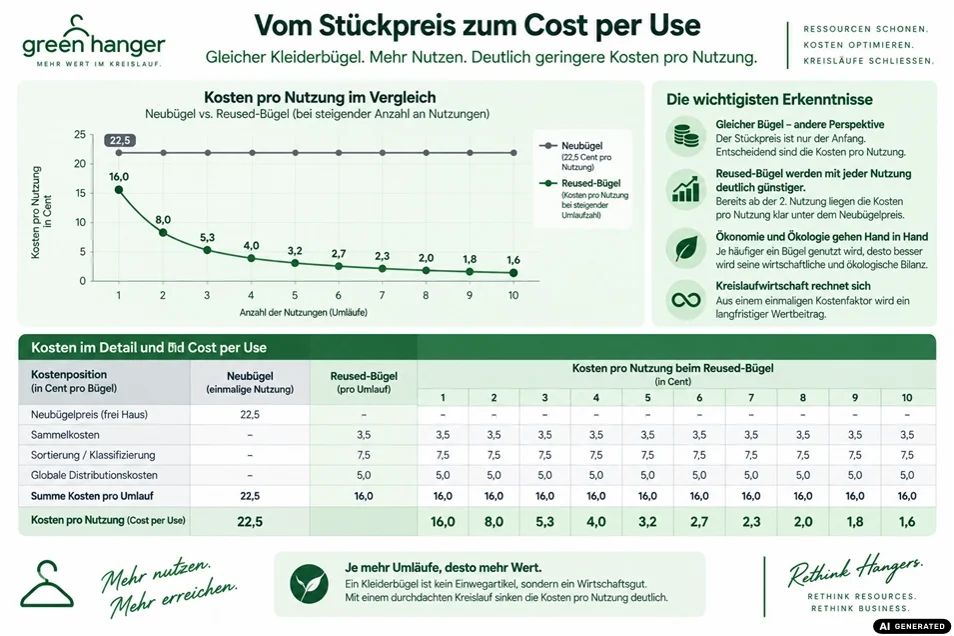
A new hanger costs 0.20 euros.
When used, the original acquisition costs are as follows:
0.20 euros per use.
If there are five successful cycles, the same original acquisition cost is allocated as follows:
0.04 euros per use.
For ten cycles:
0.02 euros per use.
Of course, this calculation would still be incomplete.
This is because each additional cycle incurs return, sorting, storage, and logistics costs.
But that is precisely where the core economic issue lies:
Are the additional costs of another production run lower than the costs of purchasing new inventory?
If so, reuse begins to generate economic value.
The unit price alone can therefore be misleading
Many purchasing decisions begin with a seemingly simple number:
How much does a new clothes hanger cost?
That’s an important number.
But it’s not enough.
For a reusable cycle, at least two factors should be considered:
Cost per Hanger
and
Cost per Use.
The first value describes the price of the item.
The second describes the costs associated with its actual use.
In a single-use model, the two can be nearly identical.
For a reusable system to function properly, they can diverge significantly from one another as the number of cycles increases.
As a result, the coat hanger transforms from a disposable item into an asset managed as part of the company’s inventory.
3. Quality: Is a used iron really inferior?
This is probably where we encounter one of the biggest misunderstandings.
“Used” is often automatically associated with “second-rate.”
In the case of professional reuse, that is precisely what should not happen.
A reused hanger should not be put back into circulation simply because it happens to still be available.
He needs to be trained.
Depending on the specific hanger model and the customer’s requirements, this may include, for example:
- Visual inspection,
- Dimensional stability,
- Functionality of the hook,
- Hook torque,
- Clip function,
- Surface condition,
- Completeness,
- Color,
- Model mapping,
- Dimensional accuracy and
- customer-specific requirements.
The key question is:
Does the bracket still meet the defined specifications?
If so, its prior use does not, in and of itself, constitute a quality defect.
If not, it must be repaired, repurposed, or removed from the product cycle.
Quality should be measurable—not just a matter of perception
This is also relevant for purchasing.
A new clothes hanger typically has a defined product specification.
Why should the rules be any different for a Reused hanger?
A professional reusable system should also define:
- which quality characteristics are tested,
- What tolerances apply,
- what types of damage are permissible,
- when a repair is possible,
- when a hanger is discarded and
- how quality is documented.
Then “used” becomes a clearly defined product category.
I therefore consider the term ” reused ” to be much more accurate.
He does not describe the condition as a supposed deficiency.
It describes the reuse of a certified product.
4. Costs: Where Do They Really Come From?
The cost comparison must also go beyond the purchase price.
The new coat hanger involves, among other things:
Purchasing costs + production costs + procurement logistics + inventory costs.
With the Reused hanger, on the other hand, the following are produced, for example:
Collection + Return Transport + Sorting + Quality Control + Storage + Re-stocking.
Repairs or cleaning may also be required.
However, some other costs can be avoided:
- New purchase,
- Disposal,
- Parts of the packaging,
- Raw material requirements and
- possibly additional procurement processes.
That’s why a professional comparison shouldn’t ask:
“How much does a new hanger cost, and how much does a used one cost?”
Rather:
“How much does it cost to use the system properly?”
That’s a completely different perspective.
Legal costs are often more important than the retail price
Especially when dealing with very large quantities, a difference of just a few cents per hanger can make a difference.
But even small operational processes can be repeated millions of times.
An unsuitable collection container.
Pickup quantities are too small.
Manual re-sorting.
Unnecessary trips.
Incorrect grouping.
Non-standardized hanger models.
Unnecessary size labels.
All of these factors can have a negative economic impact on what is otherwise a beneficial cycle.
That is why a significant part of the optimization does not lie in the product itself.
It lies in the design of the process.
A good reusable product cycle must therefore integrate purchasing, logistics, store operations, sorting, and procurement.
5. Lifespan: How long can a clothes hanger last?
Maybe “age” isn’t even the right word.
When it comes to a coat hanger used in an industrial setting, it doesn’t really matter how many years have passed since it was manufactured.
What’s more interesting is:
How many functional cycles can it achieve?
A high-quality reusable hanger can only live up to its potential if it:
- is designed to be sufficiently robust,
- retains its mechanical properties,
- remains sortable,
- can be repaired or made compliant, and
- is still needed in the respective trading system.
That is why the circular economy begins with product selection.
A particularly cheap hanger that lasts only a few uses may end up costing more over its entire lifespan than a slightly higher-quality product that can be used for many cycles.
The European Environment Agency highlights precisely this connection: durability, reuse, and more intensive use can reduce the demand for new products and the associated environmental impacts.
An interesting shift in perspective: lifespan instead of purchase price
Let’s imagine two coat hangers.
Clamp A is particularly inexpensive; it is used once and then recycled.
Clamp B costs a little more when first purchased, but it can be used ten times.
Which one is cheaper?
Without further information, we cannot answer this question.
Because we need:
- Acquisition costs,
- Response rate,
- Loss ratio,
- Sorting costs,
- Shipping costs,
- Repair costs,
- Recyclability and
- Actual number of successful cycles.
But that is precisely the key point:
The quality of a purchasing decision may not become apparent at the time of purchase—but only over the course of the product’s entire useful life.
Keep existing inventory in use for as long as possible.
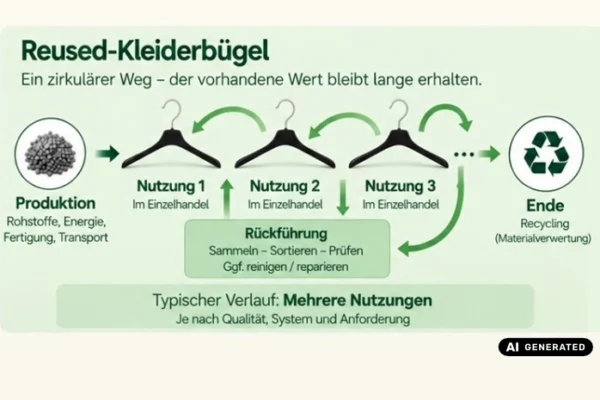
Clothespins that can no longer be used are removed from the product cycle and reintroduced into the material cycle in the highest-quality form possible.
This creates a sort of cascade:
Reused → Reused → Reused → Repair if necessary → Reused → Recycled → Secondary raw material → New product.
The longer the technically viable product phase lasts, the later additional resources will need to be allocated to replacement products.
It is precisely this combination of product longevity and high-quality recycling that embodies the fundamental principle of a circular economy.
So which one is better?
The answer may be less spectacular, but it’s more honest:
Not every reused hanger is better than every new hanger.
However, a technically sound bracket that can be removed and reused with reasonable effort should not be replaced simply because a new bracket is available.
Novelty is not an environmental indicator.
And “used” is not an indicator of quality.
The following are crucial:
Functionality. Quality. Service life. Process costs. Resource consumption. Environmental impact.
Only when considered together do these factors provide a reliable picture.
Maybe that’s why we need a new purchasing metric
Traditional shopping asks:
How much does the hanger cost?
A circular procurement approach should also ask:
How much does the hanger cost per successful use?
And perhaps even further:
How much product value do we derive from the material once it has been used?
That is exactly where ecology and economics intersect.
Using a product for a longer period of time not only has the potential to reduce material consumption and environmental impact; it can also increase the economic return on the original investment.
In my view, that is one of the most interesting aspects of the circular economy.
It does not necessarily mean:
Greater sustainability versus higher costs.
If organized properly, it can mean:
Greater sustainability through better use of existing economic assets.
And that brings us back to our central theme.
Don’t just reduce costs—turn existing costs into added value.
The next question, therefore, is: How do you measure this advantage?
So far, we have looked at the principles.
Now we can start calculating them.
How much does a disposable hanger actually cost?
How does the price per use change for five, ten, or fifteen cycles?
What are the costs associated with repatriation?
At what reuse rate does a recycling system become economically viable?
And how long does it take for a slightly higher-quality reusable hanger to pay for itself?
In the next post: “Buy Once or Invest? – The Economics of a Hanger Cycle.”
Then the idea becomes a business model.
When is it a good idea to get a new clothes hanger?
This question, too, is part of an honest assessment.
Of course, there are situations in which new hangers are needed.
For example:
- when setting up a new system,
- if additional quantities are needed,
- for new clothing lines,
- in the event of new technical requirements,
- if existing brackets no longer meet their specifications,
- if a model is permanently removed from circulation, or
- if the return flow is insufficient to meet demand.
A functioning reusable system therefore does not mean:
No more new hangers.
It means:
Only as many new hangers as are actually needed.
That is a significant difference.
New and reused should therefore not be at odds with each other
A smart cycle requires both.
New irons are being added to the inventory.
Reused hangers keep existing inventory in use for as long as possible.
Clothespins that can no longer be used are removed from the product cycle and reintroduced into the material cycle in the highest-quality form possible.
This creates a sort of cascade:
Reused → Reused → Reused → Repair, if necessary → Reused → Recycled → Secondary raw material → New product.
The longer the technically viable product phase lasts, the later additional resources will need to be allocated to replacement products.
It is precisely this combination of product longevity and high-quality recycling that embodies the fundamental principle of a circular economy.
So which one is better?
The answer may be less spectacular, but it’s more honest:
Not every reused hanger is better than every new hanger.
However, a technically sound bracket that can be removed and reused with reasonable effort should not be replaced simply because a new bracket is available.
Novelty is not an environmental indicator.
And “used” is not an indicator of quality.
The following are crucial:
Functionality. Quality. Service life. Process costs. Resource consumption. Environmental impact.
Only when considered together do these factors provide a reliable picture.
Maybe that’s why we need a new purchasing metric
Traditional shopping asks:
How much does the hanger cost?
A circular procurement approach should also ask:
How much does the hanger cost per successful use?
And perhaps even further:
How much product value do we get from the material used once?
That is exactly where ecology and economics intersect.
Using a product for a longer period of time not only has the potential to reduce material consumption and environmental impact; it can also increase the economic return on the original investment.
In my view, that is one of the most interesting aspects of the circular economy.
It does not necessarily mean:
Greater sustainability versus higher costs.
If organized properly, it can mean:
Greater sustainability through better use of existing economic assets.
And that brings us back to our central theme.
Don’t just reduce costs—turn existing costs into added value.
The next question, therefore, is: How do you measure this advantage?
So far, we have looked at the principles.
Now we can start calculating them.
How much does a disposable hanger actually cost?
How does the price per use change for five, ten, or fifteen cycles?
What are the costs associated with repatriation?
At what reuse rate does a recycling system become economically viable?
And how long does it take for a slightly higher-quality reusable hanger to pay for itself?
In the next post: “Buy Once or Invest? – The Economics of a Hanger Cycle.”
Then the idea becomes a business model.
#GreenHanger #GarmentHangers #HangerReuse #HangerLoop #ReusableHangers #ApparelIndustry #FashionRetail
Optimized by AI
About the Author

Hermann Bode
Author of *Green-Hanger* and expert on global coat hanger cycles.