The Life Cycle of a Clothes Hanger—From Source to Source
Where does a clothes hanger’s life actually begin—and where does it end?
At first glance, the answer seems simple: A clothes hanger is manufactured, carries a garment to the store, and is eventually discarded.
But this linear view does not go far enough.
For a reusable clothes hanger, the interesting part of its life often begins right where a disposable system would end.
To understand why reusing hangers can be beneficial from both an environmental and economic perspective, we must first examine their entire lifecycle.
We call him:
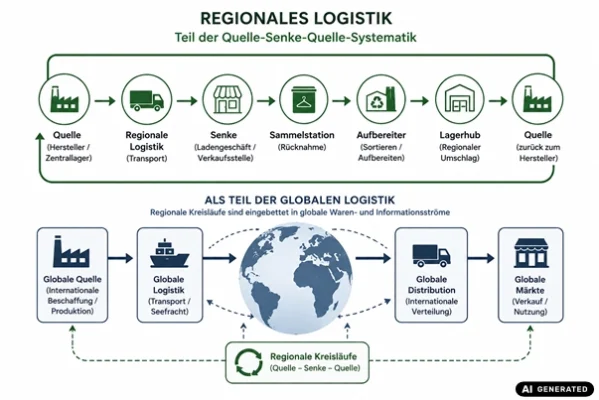
Source → Sink → Source.
Or, to put it a little more clearly:
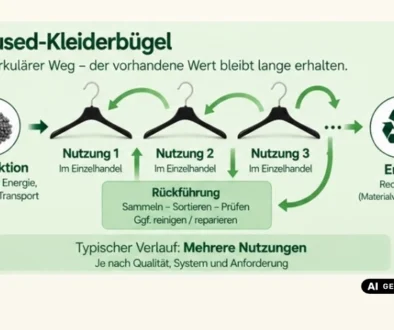
Clothing manufacturer → Transportation → Retail → Collection → Sorting → Reuse → Back to the clothing manufacturer.
Only when reuse is no longer technically or economically feasible does material recycling follow as the final step.
1. The source: the clothing manufacturer
Let’s start where hangers and clothing first come together.
In our analysis , the source is the clothing manufacturer or garment producer.
Many garments are placed on the hangers designated for the respective retailer while still at the manufacturer’s facility. The hanger thus becomes part of a much larger merchandise and logistics process.
Its purpose is not merely to hang a jacket, blouse, pair of pants, or dress. It is designed to securely hold the garment during transport, storage, order fulfillment, and display, and to facilitate efficient handling of merchandise.
This means that the clothes hanger is not an isolated packaging problem.
It is part of the supply chain.
And it is precisely this classification that is important for everything that happens afterward.
2. Transportation: The hanger comes along for the ride
The journey begins with a piece of clothing.
Depending on the region of production, the route may extend over several thousand kilometers, passing through seaports, container terminals, distribution centers, and regional warehouses, all the way to European retailers.
The hanger travels along as part of the garment.
Here’s an interesting point: The bulk of the transportation effort isn’t due to the need to transport a clothes hanger. Rather, it simply accompanies a flow of goods that would be taking place anyway.
This carries it from the spring toward the valley.
And a single hanger can quickly turn into a large number of them.
A single retail store might have a few hundred or a few thousand hangers. A large chain of stores, on the other hand, has to manage millions of hangers.
What might seem like a trivial item thus becomes a logistical consideration.
3. The Slump: Retail
In a retail store, the clothes hanger serves its most visible purpose.
He presents the merchandise.
However, once the garment has been sold, a crucial question arises:
What happens to the hanger now?
Here, a product container becomes either a waste problem—or the starting point of a new cycle.
That is exactly why we refer to the brick-and-mortar store as a “sink” in our classification system.
This is where the hangers first come in.
The key difference between a linear system and a circular system lies in what happens to them afterward.
4. What about the customer?
The customer is an important part of this process—even though they often don’t even need the hanger.
The garment is purchased. The hanger can be taken home or left at the store.
For a closed-loop hanger system, it is generally beneficial for as many suitable hangers as possible to remain within the controlled system.
This is because any hanger that leaves the defined cycle cannot simply be reused.
This means that the circular economy actually begins at a surprisingly unspectacular point:
at the register.
If the hanger stays in the store, its next journey can begin.
5. The Collection: Many small quantities come together to form a flow of goods
Now the logistics direction is reversing.
The hangers must be collected from individual stores or regional collection points.
That sounds simple, but it’s a crucial economic factor.
After all, a circular economy requires logistics.
Small quantities, inefficient transportation routes, unsuitable collection containers, or poorly coordinated pickups can place an economic burden on an environmentally sound recycling system.
That is why reusing hangers involves much more than just the question of whether a hanger can be used a second time.
The key question is:
How can we organize his return in such an efficient way that what would otherwise be a disposal expense becomes an economically viable repatriation process?
This is where regional and global logistics come together.
Collection is carried out as regionally and efficiently as possible. Larger quantities are then consolidated and integrated into the broader flow of goods.
In this way, many small returns are combined to form a flow of goods that is economically manageable.
6. Sorting: Not all hangers are the same
Just because something is collected doesn’t mean it’s reusable.
Now comes one of the most important steps in the entire process: sorting and grading.
Clothes hangers differ, among other things, in terms of:
- Type and Model
- Color
- Size and Dimensions
- Intended Use
- Hooks and Clips
- Customer or Manufacturer Specifications
- technical condition
At the same time, it must be determined whether each individual bracket is suitable for another cycle.
Is it damaged?
Are any components missing?
Is the hook still working?
Can the hanger be repaired?
Does it still meet the requirements of the intended cycle?
Sorting is therefore not merely a matter of separating waste.
It is a quality control measure for a reusable asset.
This difference is significant.
7. Reuse: The sink becomes a source again
After sorting, quality inspection, and, if necessary, reconditioning, the really interesting part begins:
The coat hanger does not become a new raw material.
It remains a coat hanger.
It can be bundled, packaged, stored, and then made available again to a clothing manufacturer.
And so we’ve come full circle.
Source → Sink → Source.
The clothing manufacturer receives a reusable hanger in good condition and can use it for a new garment.
After that, life begins anew.
Transportation.
Retail.
Collection.
Sorting.
Reuse.
And back to the source once again.
An item purchased once becomes a reusable good in a circular economy.
8. Why Reuse Comes Before Recycling
At some point, however, even a reusable clothes hanger reaches the end of its useful life.
A hanger may be damaged. A hook may be missing. Clips may be defective. A model may have been discontinued or may no longer meet technical requirements.
Therefore, the first step should be to examine:
Can the hanger be repaired or reused in some other way?
Only when this is no longer reasonably possible does the next cycle begin for us:
recycling.
In this process, the different materials should be separated as thoroughly as possible and recycled as secondary raw materials.
Plastic is still plastic.
Metal is still metal.
The product, which is no longer usable, is turned back into raw materials.
Recycling is therefore an essential part of a functioning circular economy.
But it occurs at the end of the product’s useful life—not automatically after the first use.
That’s a crucial difference.
That is why the hanger has two loops
If we look at the system as a whole, we can actually identify two distinct cycles.
The first is the product life cycle:
Use → Collect → Sort → Reuse → Use again.
This cycle should be repeated as often as possible.
Only when this cycle ends does the second cycle begin—the material cycle:
Sorting → Material separation → Recycling → Secondary raw material → New product.
Both are part of the circular economy.
But they are not the same.
And it is precisely this distinction that is often overlooked in the discussion about sustainability.
A waste disposal problem becomes a logistics system
This also changes the economic perspective.
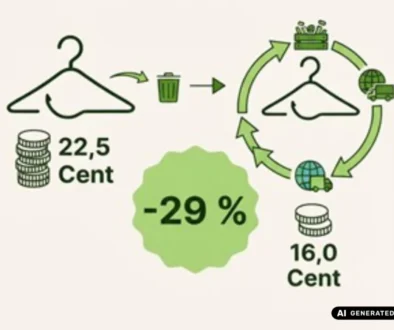
Anyone who views used hangers solely as a waste disposal problem sees costs first and foremost:
Collection, containers, storage, and removal.
On the other hand, anyone who considers the entire source-sink-source cycle may recognize that there is value there.
After all, what remains at the end of the return process is not a worthless object.
A certified, reusable coat hanger can be placed there, thereby avoiding or reducing the need to purchase new ones.
This is precisely where the connection between ecology and economics begins.
Disposal becomes recycling.
Waste becomes a resource in a circular economy.
Costs can lead to economic benefits.
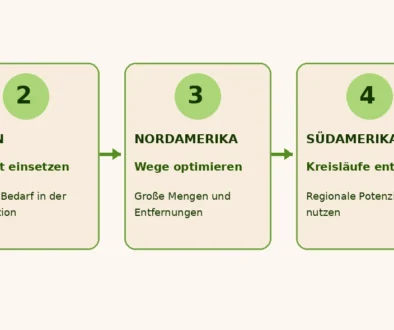
Think regionally—integrate globally
A modern clothing hanger recycling system must resolve an apparent contradiction.
Clothing is produced and traded globally. The collection of used hangers, however, begins locally—in individual retail stores.
That’s why we need both:
Regional cycles and global logistics.
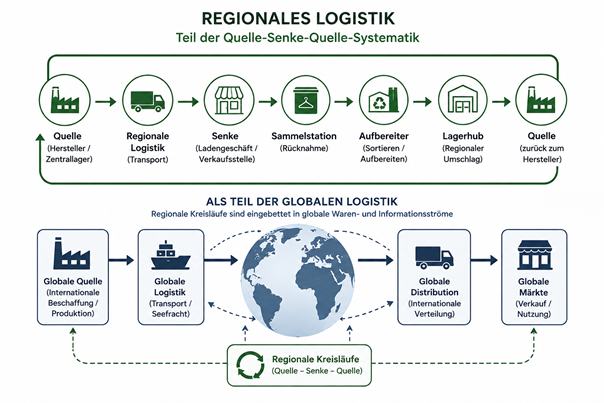
Regional logistics collects, consolidates, and processes.
The global supply chain returns the reusable hangers to where they are needed for the next round of clothing production.
Regional source-sink-source systems are therefore not an alternative to the global supply chain.
You can be part of a smartly organized global circular economy.
Looking at the System as a Whole
This brings us back to the central theme of green hanger:
Gain a better understanding of the circular economy in order to make better business decisions.
Not the individual trip.
Not the individual coat hanger.
Not the individual recycling process.
Nor is the purchase price of a new hanger the only factor that determines which system makes more sense from an environmental and economic standpoint.
What matters is the system as a whole.
How often is an iron used?
How efficient is the collection process?
What additional transportation routes will be created?
How much effort does sorting require?
How many hangers can actually be reused?
What new purchase will this prevent?
And what happens to the material at the very end of its useful life?
Only once we answer these questions can we have a meaningful discussion about sustainability and economic efficiency.
That is exactly why, in the next post, we’ll be addressing a question that sounds surprisingly simple at first:
Recycling or Reuse?
Why shred a perfectly good coat hanger only to use energy and resources to make a new one?
And are there situations in which recycling is still the better choice?
That’s what the next post is about.
#GreenHanger #GarmentHangers #HangerReuse #HangerLoop #ReusableHangers #ApparelIndustry #FashionRetail
Optimized by AI
About the Author

Hermann Bode
Author of *Green-Hanger* and expert on global coat hanger cycles.