
Why “green hanger”? – A clothes hanger isn’t trash
Why are we focusing on clothes hangers, of all things?
That’s a valid question. After all, the clothes hanger is one of those everyday items in the apparel retail industry that hardly anyone gives a second thought to in the course of daily business. It holds a garment, displays it in the store, and thus appears to serve a purely functional purpose.
It is precisely this way of looking at things that is part of the problem.
Behind the many millions of hangers that the European apparel retail sector requires year after year lies a highly relevant—yet often underestimated—circular economy and logistics structure. It encompasses purchasing, procurement, the supply chain, warehouse logistics, store operations, disposal, reuse, recycling, cost structures, and, increasingly, companies’ sustainability and ESG goals.
And in my view, there is hardly any sufficiently nuanced discussion of any of these points.
Why I Started green hanger
My name is Hermann Hubert Bode; I was born in 1964. For more than three decades, my work has centered on clothes hangers—their logistics, sorting, reuse, and recycling.
In 1995, our family joined what is now TFS global hanger management GmbH. The basic idea at the time was remarkably simple: A product that is still technically usable should not be thrown away or unnecessarily recycled after its first use, but should be reused whenever possible. Over the following decades, this idea evolved into an internationally active service model for reusable hangers and closed-loop hanger cycles.
Today, I am the managing partner of TFS global hanger management GmbH. My professional career has previously included roles in the textile industry and in business development; since the mid-1990s, managing hanger recycling systems has been the focus of my work.
More about my personal and professional background
So why yet another website?
Because I’m increasingly finding that, in a business context, discussions about hangers, recycling, and the circular economy are often based on assumptions that are well-intentioned but not always accurate or fully thought through.
“green hanger” is designed to help you take a closer look.
An old problem that has suddenly become very relevant
The issue of used hangers predates today’s industry-wide discussions on sustainability and ESG by a long shot.
Decades ago, as the volume of goods increased, logistics structures became more centralized, and brick-and-mortar clothing retailers expanded their store networks, large quantities of used hangers began to accumulate. What seemed like an insignificant item in any single store became, when taken as a whole, a significant logistical and economic issue.
Where should I put the hangers?
Landfill? Incinerate? Shred? Recycle? Or reuse?
This very practical question led to the development of take-back, sorting, and reuse systems. What was primarily a solution to a waste disposal and cost problem back then is what we would now call an integral part of a circular economy within the retail system.
Interestingly, the fundamental question has remained the same to this day:
What do we do with a clothes hanger after it has served its original purpose in the retail process?
Recycling sounds good—but it isn’t automatically the best solution
This is exactly where many misunderstandings begin.
“The hanger is recycled, after all.”
At first glance, that sounds sustainable. But why would a fully functional clothes hanger be shredded at all if it can be reused in the operational system?
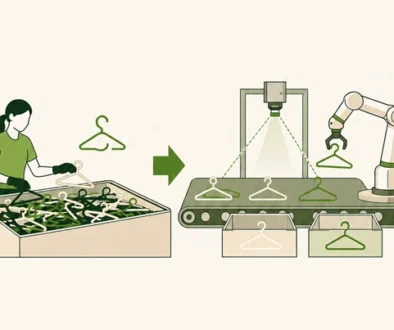
To be recycled, it must be collected, transported, sorted by material, shredded, and processed industrially. It is then turned back into a raw material that is used to manufacture a new product.
If, on the other hand, the same hanger can be reused in the retail system, a significant portion of this process chain becomes unnecessary for the time being.
Consequently, current industry and sustainability guidelines are increasingly distinguishing between recycling and reuse. The Fashion Pact, for example, identifies reusable packaging and carrier systems as a means of reducing costs and environmental impact and points to existing closed-loop systems in the retail sector.
That doesn’t mean recycling is wrong.
On the contrary.
Recycling is essential when a clothes hanger can no longer be used within the system. But recycling should not be equated with reuse.
This distinction will be a recurring topic for us here at green hanger.
Turning Costs into Economic Benefits
The business perspective is at least as important as the environmental one.
First, a clothes hanger is purchased. From a traditional perspective, this results in direct unit costs.
If it is used once and then removed from the system, these costs are allocated to exactly one use in the trading process.
If, on the other hand, the same hanger is processed multiple times in the system, the calculation changes significantly.
As a result, what was once purely a consumable item is increasingly becoming a reusable product and part of a circular economy within the supply chain.
Of course, reuse isn’t free. Hangers must be collected, transported, sorted, inspected, repaired if necessary, stored, and reintegrated into the appropriate logistics processes.
That is exactly why the blanket statement “Reuse is more sustainable” is not enough.
The key question is:
At what point does the additional process effort translate into a measurable economic and environmental benefit for the company?
I’d like to discuss this on green hanger—using statistics, practical experience, and examples where reuse on an industrial scale isn’t the best solution.
This is because a circular economy can only function sustainably in a business context if environmental and economic interests are aligned.
Who is green hanger intended for?
green hanger is specifically aimed at commercial decision-makers in the apparel retail and textile industries.
The focus is particularly on:
Managers from the areas of purchasing, procurement, logistics, supply chain management, sustainability, and ESG management, as well as CEOs and decision-makers at medium-sized companies and international apparel corporations.
In practice, conflicts of interest often arise precisely between these functions.
Purchasing optimizes unit costs.
Logistics optimizes processes and turnaround times.
Sustainability and ESG management optimize carbon footprints and resource use.
Management expects overall financial responsibility.
What if a professionally organized coat hanger recycling program could meet several of these requirements at once?
Not everything that looks green is circular economy
That is why green hanger should not be a platform for simple answers or marketing claims.
I’d like to ask some questions.
I would like to test some hypotheses.
And I would like to share my experiences from more than three decades of practical work with reusable hangers in the industry for discussion.
When does recycling make sense?
When is reuse in the system economically and environmentally superior?
Is a new clothes hanger made from recycled material really better than an existing hanger that has already been in circulation several times?
How much extra logistics is a recycling system actually worth?
At what point do supposed disposal costs become a structural economic factor?
And what happens at the actual end of a reusable clothes hanger’s life cycle on an industrial scale?
These are not theoretical questions. They are operational and strategic decisions that directly affect companies’ procurement, logistics, cost structure, and environmental impact.
Take a closer look instead of jumping to conclusions
Perhaps that is the most important motivation behind green hanger:
Gain a better understanding of the circular economy in order to make better business decisions.
Not every type of plastic is automatically problematic.
Not every form of recycling is automatically the best solution.
Not every instance of reuse is automatically economically viable.
And not every supposedly sustainable alternative is actually the better option for a company when considering its entire life cycle.
We must therefore consider the entire system —from clothing manufacturers through the international supply chain and the retail network to collection, sorting, reuse, and finally material recycling.
That’s exactly what I want to do with this series of articles.
Step by step.
And we’ll start with the coat hanger itself.
In the next post: “The Life Cycle of a Hanger System—From Source to Source.”
Because before we talk about recycling, reusable items, or CO₂, we should first understand the surprisingly long and systemically important journey that a seemingly simple clothes hanger actually takes in the retail sector.
#GreenHanger #GarmentHangers #HangerReuse #HangerLoop #ReusableHangers #ApparelIndustry #FashionRetail
Optimized by AI
About the Author

Hermann Bode
Author of *Green-Hanger* and expert on global coat hanger cycles.