

New Oil Pipelines—A Stable Oil Supply, Stable Prices for Clothes Hangers?
What impact will the new and planned detour routes have on the global coat hanger market?
What does an oil pipeline in the Persian Gulf have to do with the price of a clothes hanger in Europe or Asia?
At first glance, not much. In fact, there is a direct economic link stretching from crude oil through petrochemical precursors and plastic pellets all the way to the finished coat hanger. The Strait of Hormuz is one of the most critical chokepoints in global trade. Before the recent disruptions, around 20 million barrels of crude oil and petroleum products were transported there daily—about one-fifth of global oil consumption. Asia is particularly dependent on these shipments: a large portion of the supplies from the Gulf go to China, India, Japan, South Korea, and Southeast Asia.
That is why new oil pipelines are being built or proposed that are intended to bypass the Strait of Hormuz. But what do these projects mean for coat hangers, reusable coat hangers, and closed-loop coat hanger systems?
Oil Routes Bypassing Iran
Planned Pipelines and Ports in the Gulf States
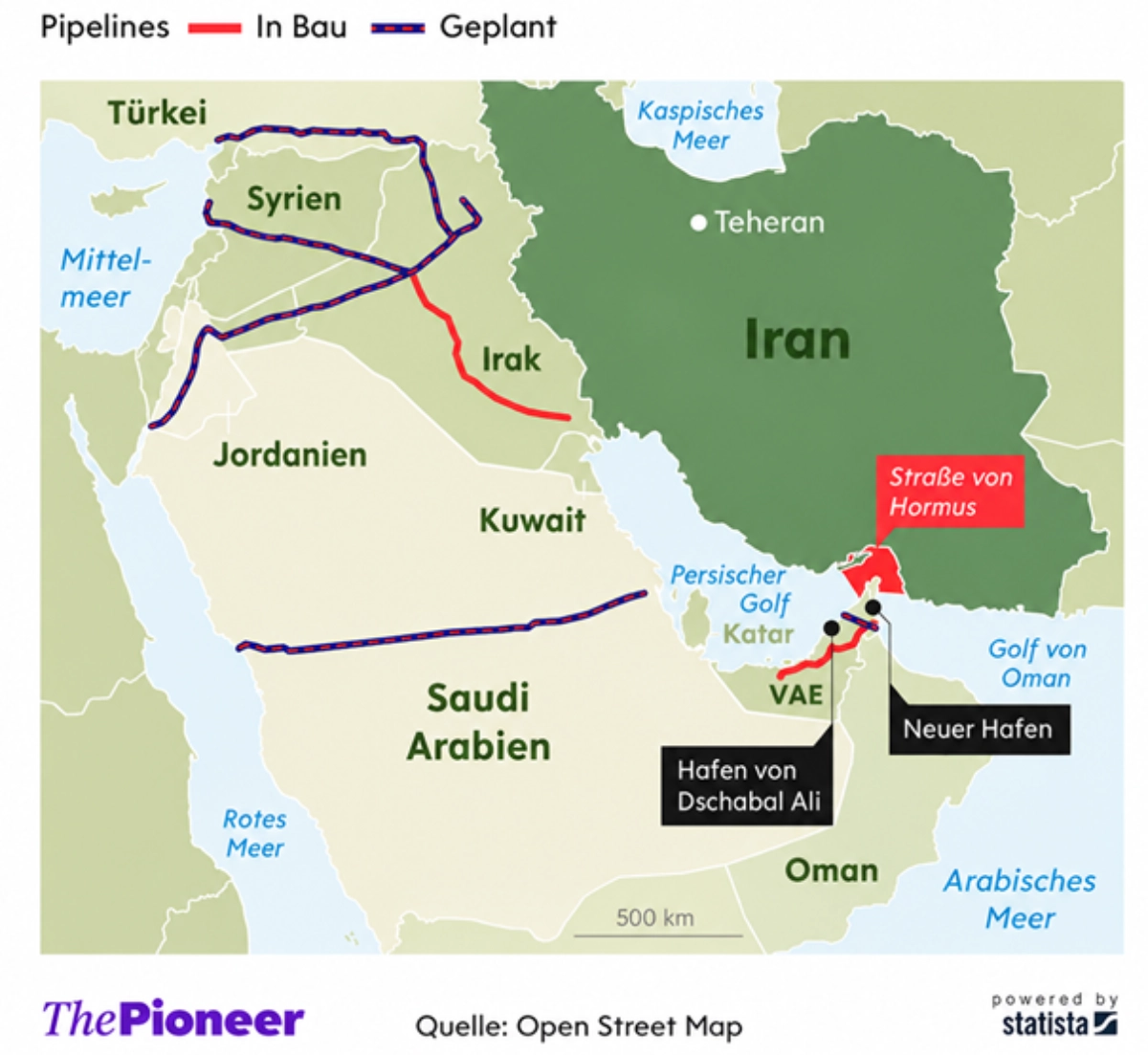
Six projects—but not six surefire solutions
The focus is on six major pipeline corridors: the expansion of the connection from the United Arab Emirates to Fujairah, the Iraqi route from Basra to Haditha, and potential connections to Jordan, Syria, and Turkey. In addition, there is a potential extension of the Saudi East-West Pipeline to the Red Sea.
The new pipeline from the United Arab Emirates to Fujairah is the most advanced. It could significantly increase export capacity outside the Strait of Hormuz by 2027. Iraq is also moving forward with the approximately 700-kilometer pipeline from Basra to Haditha. However, many other routes are still in the planning stages, consist of political declarations of intent, or involve the reactivation of old corridors. Their completion depends on financing, security, regional cooperation, and additional ports.
The pipelines enhance the security of supply. However, they do not completely replace Hormuz. Furthermore, routes heading west create new dependencies: on the Red Sea, the Bab al-Mandab Strait, the Suez Canal, or politically sensitive transit countries.
Crude oil is not yet plastic pellets
For the coat hanger market, one distinction is crucial: The new pipelines primarily transport crude oil. Coat hangers, however, are not made directly from crude oil. In between lie refineries, naphtha, LPG, ethane, monomers such as ethylene, propylene, and styrene, and finally plastics such as polypropylene and polystyrene.
A secure supply of crude oil can stabilize refineries and naphtha crackers. However, it does not guarantee a secure supply of plastic raw materials. LPG, ethane, intermediate products, and finished pellets must still frequently be shipped through the Strait of Hormuz or via Gulf ports. Added to this are container availability, insurance, shipping space, port operations, and freight rates.
The International Energy Agency estimates that Gulf states will export approximately 1.5 million barrels of LPG per day and 3.3 million barrels of refined products in 2025. It is precisely these material flows that have been severely disrupted by recent disruptions. This shows that even if crude oil can flow through a pipeline, petrochemical plants may have to reduce production and plastic pellets may be stranded at the port.
What does this mean for PP and PS hangers?
Many plastic hangers are made primarily of polypropylene (PP) or polystyrene (PS). PP production depends, among other things, on propylene, propane, and refinery capacity. PS production requires benzene and styrene and is therefore also closely linked to refineries and the naphtha supply chain.
The new pipelines can cushion extreme spikes in crude oil prices. However, they do not prevent short-term price surges in PP and PS. In a crisis, price fluctuations may even shift from crude oil to granules, energy, and freight. For manufacturers of new clothes hangers, this means:
- sharp fluctuations in the purchase prices of PP and PS,
- longer or uncertain delivery times,
- higher shipping and insurance costs,
- regional price differences between Europe, Asia, and Southeast Asia,
- additional costs for safety stock.
Companies that produce coat hangers exclusively from virgin materials, purchase them on short notice, or rely on a single raw material supplier are particularly vulnerable. A low oil price is therefore by no means a guarantee of a low coat hanger price.
What should the market expect?
Under normal conditions, the new pipelines are likely to slightly reduce the risk premium on crude oil and improve supplies to Asian refineries. The most important route for Asia is Fujairah, because the port is located east of the Strait of Hormuz and tankers can sail directly from there to India and Southeast Asia.
However, in the event of a renewed escalation, the picture remains mixed: Crude oil could become more readily available, while LPG, monomers, granules, and containers could become scarce and expensive. Therefore, the Brent price is not the only factor relevant to the global clothes hanger market. Other leading indicators include the prices of naphtha, propane, propylene, styrene, PP, and PS, as well as freight rates from the Gulf and within Asia.
Another risk is also often underestimated: New pipelines do not eliminate geopolitical risks. They merely spread them across more routes, pumping stations, and export terminals. Fixed infrastructure can be damaged or blocked. Furthermore, a pipeline’s nominal capacity can only be utilized if ports, storage tanks, pumps, and suitable crude oil grades are all compatible.
How can unpredictable price fluctuations be avoided?
Price fluctuations cannot be completely avoided. However, dependence on them can be significantly reduced.
First, companies should diversify their procurement regionally and across multiple suppliers. Long-term contracts, pricing formulas, and agreed-upon volume ranges provide greater planning certainty than purely spot purchasing.
Second, it makes sense to maintain adequate safety stock levels for granules, additives, and particularly important coat hanger models. The goal here is not to have the largest possible inventory, but rather to maintain stock levels calculated based on risk.
Third, manufacturers should review the materials used, the percentage of recycled content, and the design of their hangers. Recycled materials can help reduce costs compared to virgin petrochemical-based materials—provided that quality, color, and technical properties are ensured.
However, the most effective approach lies elsewhere: reusable hangers, hanger reuse, and closed-loop hanger systems.
Every clothes hanger that is collected, sorted, and reused does not need to be manufactured from scratch. Its cost-effectiveness therefore depends less on crude oil, plastic pellets, and ocean freight. Closed-loop hanger systems turn a product purchased once into a reusable asset. They simultaneously reduce material consumption, waste, CO₂ emissions, and the risk of unpredictable purchase prices.
The strategic answer is reuse
The new oil pipelines are important. They make the global market more resilient and can limit the consequences of a disruption in the Strait of Hormuz. However, they do not provide complete protection for the coat hanger market. This is because the journey from crude oil to a coat hanger remains dependent on refineries, petrochemical feedstocks, granules, ports, and freight.
Therefore, anyone seeking to achieve long-term cost stability should not rely solely on new oil transportation routes. A more effective strategy is to reduce the demand for new plastic production.
Reusable hangers, professional hanger reuse, and closed-loop hanger systems are thus far more than just environmental measures. They are risk management tools. In a world of volatile raw material prices, reused hangers become not only more sustainable but also more economically valuable.
*As of July 16, 2026. Project schedules and capacities are subject to change due to the political and security situation.*
Sources
[International Energy Agency: Oil Market Report, March 2026](https://www.iea.org/reports/oil-market-report-march-2026)
[International Energy Agency: Adjustments to Global Oil Supplies Following the Hormuz Shock](https://www.iea.org/commentaries/how-global-oil-supplies-have-readjusted-to-help-fill-the-huge-gap-left-by-the-strait-of-hormuz-shock)
[International Energy Agency: Measures to Cope with Oil Price Shocks](https://www.iea.org/news/new-iea-report-highlights-options-to-ease-oil-price-pressures-on-consumers-in-response-to-middle-east-supply-disruptions)
[Reuters: Planned Port on the UAE’s East Coast](https://www.reuters.com/world/middle-east/dp-world-plans-uae-east-coast-port-bypass-strait-hormuz-ft-reports-2026-07-13/)
#GreenHanger #GarmentHangers #HangerReuse #HangerLoop #ReusableHangers #ApparelIndustry #FashionRetail
Optimized by AI
About the Author

Hermann Bode
Author of *Green-Hanger* and expert on global coat hanger cycles.