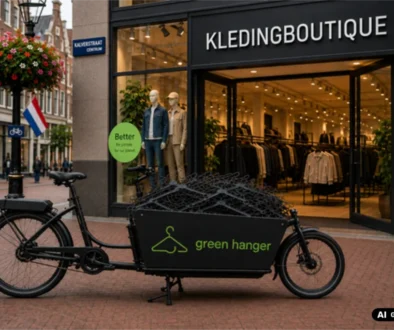

What does the future hold for reusable hangers?
The future of reusable hangers looks promising. This is true from both an economic and an environmental perspective. Of course, the assessment always depends on one’s point of view. However, anyone who wants to continue consuming large quantities of clothing in the future while also using resources responsibly will find it hard to do so without effective reusable systems.
This statement is based not only on theory, but on more than 30 years of experience in the coat hanger industry.
A simple cycle with a big impact
The basic process is easy to explain: Used hangers are collected, sorted, and then redistributed. A cycle could hardly be simpler.
In practice, however, there is much more to it than that. The hangers must be collected from many clothing stores. This requires suitable collection containers, well-organized transportation, and efficient logistics. This incurs costs for vehicles, drivers, fuel, tolls, and, increasingly, CO₂ taxes.
Billions of clothes hangers in circulation
The numbers are staggering. Around 20 billion hangers are needed worldwide each year. In Europe alone, the figure is about 5 billion. Europe’s three largest apparel retail groups together require about 1.6 billion hangers per year.
Based on an average purchase price of 12.5 cents per clothes hanger, the annual market volume for Europe amounts to approximately 625 million euros. The three largest retail companies spend about 200 million euros per year on this.
These figures clearly show why coat hangers are no longer considered disposable items. Many retail companies already operate their own reusable systems or are continuously expanding them.
CO₂ Is Becoming a Decisive Factor
In addition to costs, environmental factors are playing an increasingly important role. The production of the coat hangers needed in Europe alone generates approximately 2.45 million kilograms of CO₂ annually. Added to this are emissions from transportation and distribution.
Reusing clothes hangers not only reduces material consumption and costs, but can also make a significant contribution to lowering emissions.
Logistics is under pressure
Everyone is familiar with the many trucks on Europe’s roads. They are the backbone of modern supply chains. At the same time, it is becoming increasingly difficult to find enough drivers. High stress levels, increasing traffic, numerous legal regulations, and high training costs make the profession less attractive than it used to be.
According to estimates, there is a shortage of between 245,000 and 500,000 professional drivers in Europe. This problem affects the entire economy and, consequently, the coat hanger industry as well.
People remain indispensable
The collected hangers are brought to central locations and sorted there. What sounds simple is, even today, a task that people are particularly good at.
People quickly and reliably recognize shapes, materials, and differences. They can grasp, feel, and see. No machine has yet been developed that can fully replace these abilities. That is why humans remain an indispensable part of the process.
Working in the clothing hanger sorting industry is not a highly regarded job. Earning potential is limited, and opportunities for career advancement are modest. Nevertheless, this work makes an important contribution to the environment and the economy. Unfortunately, the low status of the job makes it even more difficult to find workers.
Why not just move operations to Asia?
It is often suggested that sorting operations be moved to Asia or Africa because there is a larger labor force available there. At first glance, this sounds logical. Upon closer examination, however, new challenges arise.
Even when compacted well, unsorted hangers take up significantly more space during transport than packaged new merchandise. Furthermore, not all of the collected hangers are needed in Asia or Africa. High-quality clothing for the European market often requires hangers that are sourced from Europe.
Experience shows that about 25 percent of reused hangers remain in Europe, while about 75 percent are sent to Asian manufacturing countries.
Europe remains the most important source
Used hangers come from places where clothing is sold—and that is still predominantly Europe. Clothing production, on the other hand, takes place mainly in China, Bangladesh, and other Asian countries.
That is why it is crucial to manage the flow of goods intelligently. The right hanger must be available at the right place and at the right time. A hanger in stock in Bangladesh is of little use if it is needed in Turkey on short notice. A stable and efficient supply chain is therefore of paramount importance.
Reuse or recycling?
In the United Kingdom, there are legal requirements that are increasingly mandating the use of polypropylene (PP) for packaging and similar products. The advantage is that recycling is easier, since different materials no longer need to be separated.
However, other materials often offer better properties for repeated reuse. Polystyrene has proven to be particularly suitable for many applications. Therefore, the choice of material should always take the entire life cycle into account.
Sorting is moving to Asia
A clear trend is already evident. More and more service providers are shifting their sorting capacity to Southeast Asia. Many companies have already established their own sorting facilities there and are continuing to invest in their expansion.
The reasons for this lie primarily in Europe’s high labor costs and the growing labor shortage. However, the lower labor costs are partially offset by additional transportation costs. On the other hand, the hangers are located closer to the clothing manufacturers and can be put back into use more quickly.
There is still great potential
Despite this trend, Europe remains the most important source of reusable hangers. Large retail companies are already operating successful reusable systems. However, there is still significant potential for improvement, particularly among small and medium-sized clothing retailers. This applies above all to logistics, supply chains, and the management of waste materials.
In addition, technical improvements can further increase the benefits of a reusable system. These include more robust hanger designs, improved light resistance, longer-lasting hooks and clips, and the ability to repair them. This extends the service life and, consequently, the cost-effectiveness of the systems.
Conclusion
Reusable hangers have a bright future. Rising raw material prices, increasing environmental requirements, and the desire for sustainable supply chains all clearly point toward reuse.
At the same time, logistics, sorting, and product development must be further improved. If this is achieved, what is currently a simple tool for displaying clothing will become a valuable capital good with real added value—for clothing retailers, manufacturers, consumers, and the environment.
#GreenHanger #GarmentHangers #HangerReuse #HangerLoop #ReusableHangers #ApparelIndustry #FashionRetail
Optimized by AI
About the Author

Hermann Bode
Author of *Green-Hanger* and expert on global coat hanger cycles.