According to Destatis, to fully offset the demographic decline, approximately 570,000 people between the ages of 20 and 66 would need to immigrate to Germany annually from 2025 to 2035. At the same time, it is projected that by 2035, one in four residents of Germany will already be at least 67 years old. (Destatis: 16th Population Projection)
In simple terms, the development can be described as follows:
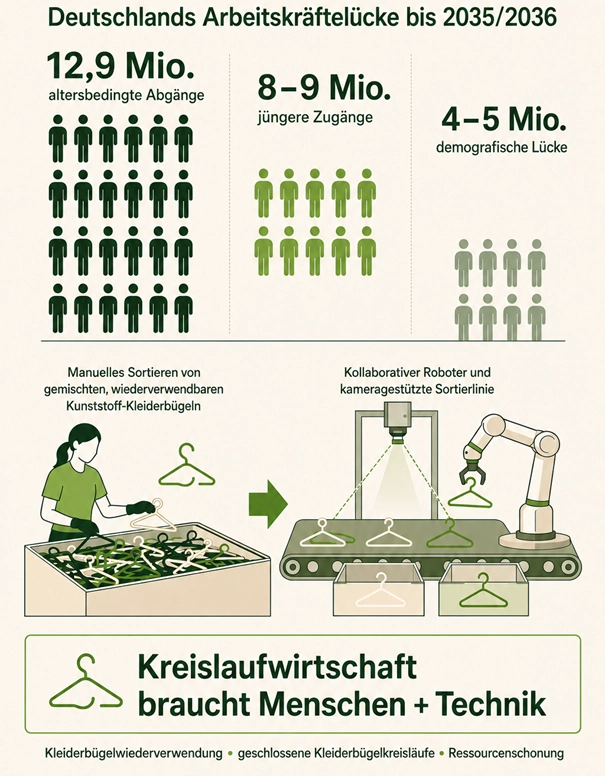
Retirements: 12.9 million
Recent additions: approx. 8–9 million
Demographic gap: approximately 4–5 million
The younger domestic cohorts are expected to be able to replace only about two-thirds of the age-related departures.
The European Union is also aging
Germany cannot rely indefinitely on other EU countries to fill its labor shortages. In those countries, too, the population is aging and the younger generations are getting smaller.
At the beginning of 2025, approximately 263 million people aged 20 to 64 lived in the EU. That represented 58.3 percent of the total population. The EU population is expected to peak in 2029 at approximately 453 million and then slowly decline. The share of the working-age population will decline significantly over the long term.
Demographic pressure is particularly high in Italy, Greece, Portugal, Croatia, Bulgaria, Latvia, Lithuania, Romania, and Poland. The situation is somewhat more favorable in Ireland, Luxembourg, Malta, Cyprus, and Sweden, among others. However, even in those countries, there may be labor shortages in certain regions or specific industries. (Eurostat: EU Population Projections)
For closed-loop clothing hanger systems, this means that simple jobs will not automatically be easy to fill just because they do not require any special training.
Why It’s Getting Harder to Fill Positions in the Clothing Hanger Sorting Industry
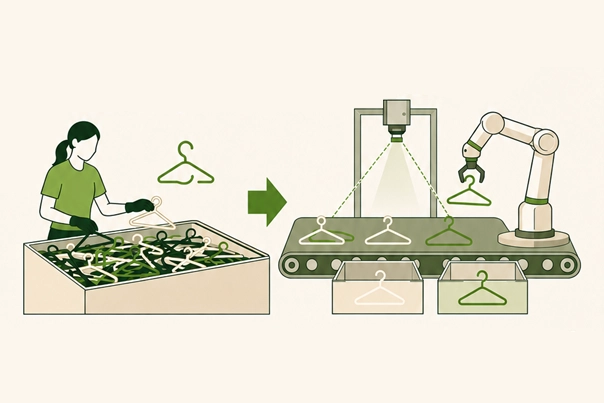
Sorting used hangers is an important task in the circular economy. Each hanger must be inspected and sorted by model, color, material, quality, and usability. Damaged hangers must be separated and sent for material recycling.
The job is easy to learn, but it is repetitive and physically demanding. These types of jobs compete with those in logistics, retail, food service, cleaning, caregiving, and manufacturing.
Companies must therefore expect rising wages, higher employee turnover, and greater difficulty filling open positions. The shortage of workers can increase the cost of reusing hangers and limit the effectiveness of closed-loop hanger systems.
From a sustainability perspective, this would be problematic. If reusable hangers can no longer be sorted economically, the pressure to recycle them prematurely or replace them with new ones increases. Recycling is important—but reuse comes first in the waste hierarchy. Every coat hanger that is reused extends the lifespan of resources that have already been used.
Automation and robotics are becoming indispensable
Automated work processes can reduce staffing needs while improving working conditions. Possible examples include:
- automatic feeding and separation of the hangers,
- Camera systems for detecting model, color, and damage,
- artificial intelligence for quality assessment,
- Robotics for Gripping, Stacking, and Packaging,
- automatic counting and documentation,
- Digital traceability within closed-loop coat hanger systems.
However, full automation remains a challenge. Used hangers come back unsorted, tangled together, dirty, or damaged. Different hooks, size rings, tags, and materials make automatic gripping difficult.
That is why partial automation makes sense as a first step. Machines handle transportation, separation, counting, and pre-sorting. People check difficult cases and ensure quality. This increases productivity per hour worked while reducing physically demanding tasks.
The location also needs to be rethought
Demographic trends are forcing companies to reevaluate not only their technology but also their locations. Sorting should take place where return volumes, a suitable workforce, and sales markets can be effectively brought together.
For the global reuse of hangers, it may make sense to process them closer to clothing manufacturers in Asia or Southeast Asia. That’s where the sorted hangers are needed for the next shipment of clothing. This allows for the organization of closed-loop clothing hanger cycles on an international scale and helps avoid unnecessary transportation.
However, relocating production is sustainable only if social standards, quality, resource conservation, and verifiable reuse are guaranteed. A circular economy must not simply mean shifting waste to other countries.
Motivation, loyalty, and a sense of responsibility stem from a job well done
Motivation and loyalty are not traits that certain generations automatically lack. They result from fair pay, job security, respectful leadership, and clear goals.
Anyone who sorts hangers should be aware of how this work contributes to sustainability. A certified hanger is not waste, but a product that can be reused. This appreciation must also be reflected in workplace design, ergonomics, opportunities for growth, and pay.
The future of coat hanger recycling therefore lies in a combination of robotics, partial automation, skilled immigration, good working conditions, and an international location strategy.
In the future, closed-loop clothing hanger systems will not succeed solely on the basis of environmental goals. They must be technically efficient, economically viable, and organized in a socially responsible manner.
After all, a true circular economy starts with a simple decision: A usable clothes hanger remains a clothes hanger—and doesn’t become waste before its time.